
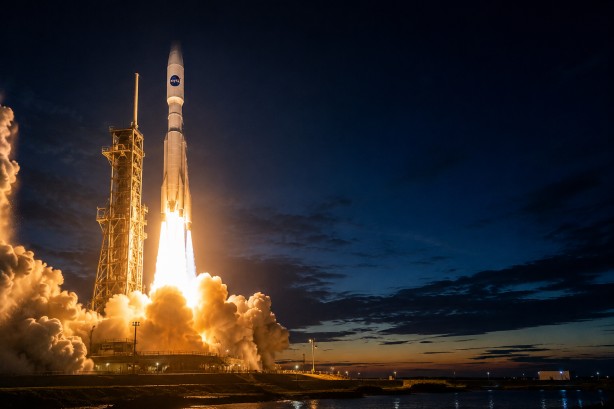
The Nancy Grace Roman Space Telescope has embarked on its ambitious mission from NASA’s Kennedy Space Center in Florida, heading nearly a million miles from Earth. With a budget of $4.3 billion, this observatory aims to delve into the universe’s greatest mysteries, such as exoplanet exploration, planetary and galaxy formation, and more. Its launch aboard a SpaceX Falcon Heavy rocket marks a pivotal moment for a mission that has been in development for nearly a decade.
Unlike its predecessors, Roman is designed to work alongside the Hubble and James Webb Space Telescopes, offering complementary insights rather than replacing them. The telescope’s defining feature is its powerful 300-megapixel infrared camera, which will deliver images with Hubble-like resolution but across a field of view over 100 times larger. Each image will be able to capture a sky area approximately 1.5 times the apparent size of the full Moon, opening new possibilities for astronomical observations.
Among Roman’s key technological advancements is a coronagraph, an instrument that can obscure the bright glare of stars, thereby providing scientists the opportunity to observe planets orbiting those stars in more detail. This capability is expected to unveil previously hidden worlds, including older and colder planets in close orbits around their stars. Roman’s destination is the Sun-Earth Lagrange Point 2, a stable region in space shared with the James Webb Space Telescope, from which it will carry out a diverse range of observations over its planned five-year primary mission, with potential extensions.
Researchers anticipate that Roman will shed light on enigmatic phenomena such as dark matter, dark energy, distant galaxies, exploding stars, black holes, and the planets beyond our solar system. Its expansive field of observation could also reveal new targets for more detailed exploration by the Hubble and Webb Telescopes. The scientific community eagerly awaits the first images from Roman, expected in early 2027 after a period of testing and calibration. NASA intends to make these images publicly accessible, offering a wealth of astronomical data to both researchers and amateur astronomers.
This mission stands as a testament to NASA’s resilience, having overcome proposed budget cuts that threatened its existence. While there were previous plans from the White House to terminate the Roman project, Congress ultimately ensured its continuation by preserving funding. With its successful launch, Roman ushers in a new era in the exploration of the universe, seeking answers to fundamental questions about the cosmos’ expansion, planetary formation, and evolution over billions of years.