
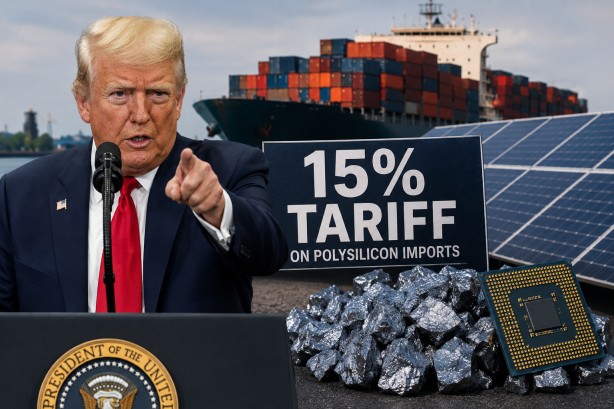
President Donald Trump has announced a new policy imposing a 15% tariff on imported goods containing polysilicon, a critical component in both semiconductor and solar panel manufacturing. Scheduled to take effect on December 4, the tariff aims to bolster U.S. domestic production and decrease dependency on imports from China, which currently leads global polysilicon production.
Polysilicon, known for its ultra-pure composition, serves as a fundamental element in the production of semiconductors essential for powering artificial intelligence systems and data centers, as well as in creating solar cells and panels. The newly announced trade measures set minimum import prices at $21 per kilogram for polysilicon, $100 per kilogram for polysilicon ingots and wafers, $0.22 per watt for solar cells, and $0.38 per watt for solar modules and panels.
The U.S. administration emphasizes that these tariffs are part of a strategy to reinforce the commercial viability of domestic polysilicon production and to enhance supply chains that are crucial for both economic stability and national security. In response, China has criticized the U.S. decision, accusing it of exploiting national security issues to unfairly limit Chinese business operations, and warning that this protectionist move could harm trade relations between the two nations.
Currently, the U.S. polysilicon production is largely centered around two significant facilities: Hemlock Semiconductor’s plant in Michigan and Wacker Chemie’s operations in Tennessee. In addition to the tariffs, the new policy allows for the establishment of incentives to encourage investment in domestic polysilicon and related manufacturing sectors.
This measure comes amid China’s continued robust growth in exports, especially in sectors like electronics and artificial intelligence-related products, underscoring its expanding influence in high-value global manufacturing markets.