
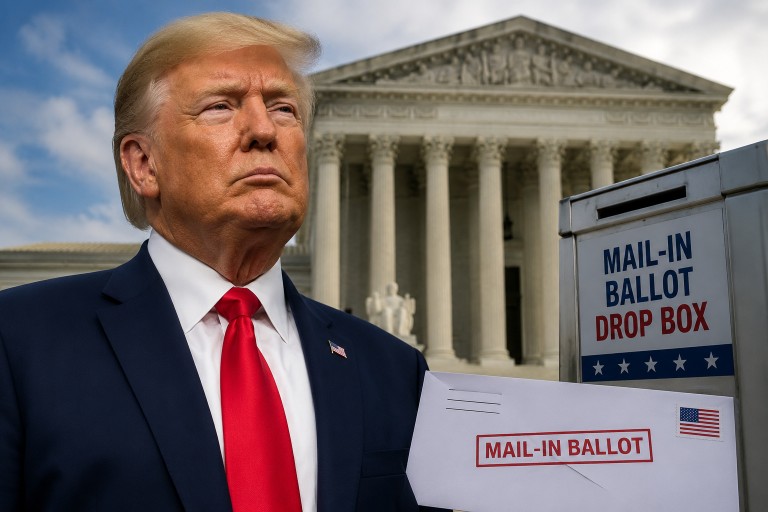
In a significant legal development, the US Supreme Court has provided the Trump administration with the green light to partially advance its initiative to reform mail-in voting processes prior to the November 2026 midterm elections. This decision, delivered in a 6-3 vote by the court’s conservative majority, lifts one of the injunctions that had previously prevented the implementation of President Donald Trump’s executive order. Despite this, a separate injunction remains active, meaning the administration’s full execution of the policy still faces legal hurdles.
Issued in March, the executive order mandates the federal government to compile a roster of eligible voters based on citizenship, stipulating that mail-in ballots should only be dispatched to individuals on this list. Additionally, it seeks to enhance federal oversight of state and local election officials concerning voter eligibility. This directive has sparked opposition from Democratic leaders in 23 states and Washington, DC, who argue that the US Constitution delegates the responsibility of election administration to states and Congress. They caution that significant alterations to voting protocols so close to the election could disrupt preparations and impede eligible voters’ ability to participate in the election.
The legal battle began when a Massachusetts judge ruled against the order, asserting that the president lacked the authority to regulate state-administered federal elections. This decision was later upheld by an appeals court, and another nationwide injunction was also imposed. However, the Supreme Court emphasized that the lifting of the initial injunction does not automatically validate every measure the administration might pursue under the order. Consequently, ongoing legal disputes will play a crucial role in determining the extent to which the policy can be enacted.
Democratic officials and voting rights advocates have strongly criticized the Supreme Court’s decision, expressing concerns that the proposed changes could engender confusion and hinder the voting process for eligible citizens. States like California are gearing up for additional legal challenges. This contentious issue arises with less than 100 days remaining before the midterm elections, where the composition of the US House of Representatives and Senate will be decided. Mail-in voting has become a pivotal component of the US electoral framework, with approximately 30% of the electorate opting to vote by mail during the 2024 presidential election.
Throughout his presidency, Trump has consistently cast doubt on the security of mail-in voting, calling for extensive reforms as part of his administration’s broader electoral policy objectives. As the nation approaches the midterms, the debate over mail-in voting continues to underscore the broader discourse on electoral integrity and access.