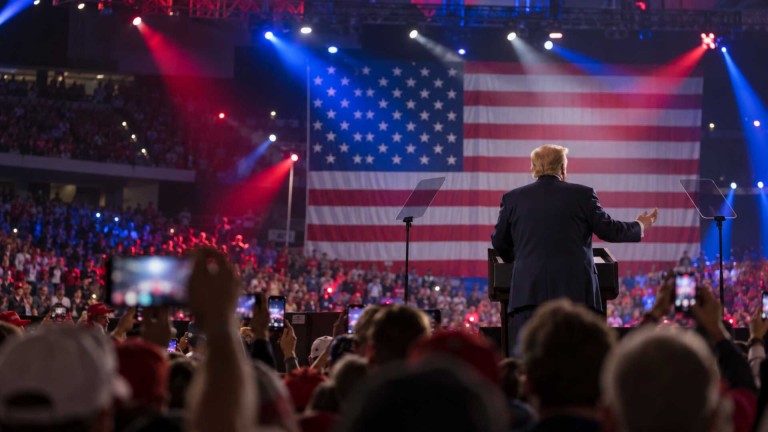
As the November midterm elections approach, US President Donald Trump has reversed his earlier decision to cancel campaign rallies in Kansas and Iowa. These in-person events, originally replaced by virtual appearances, have been reinstated as key components of the Republican campaign strategy to maintain control of Congress.
The Republican National Committee had initially announced that Trump would forgo the Kansas and Iowa rallies in favor of participating in multiple tele-rallies aimed at reaching voters nationwide. However, the campaign plans were updated on Friday, reintroducing the Kansas and Iowa events alongside 19 virtual campaign appearances.
The upcoming midterm elections represent a crucial assessment of Trump’s influence, with Republicans contending in competitive races that could alter the balance of power in both the House of Representatives and the Senate. Democrats aim to leverage voter dissatisfaction to reclaim congressional seats, capitalizing on issues such as economic concerns and opposition to current administration policies.
In Kansas, the race for the Senate seat held by Republican Senator Roger Marshall has gained attention as he faces a strong challenge from Democratic candidate Adam Hamilton. The contest is notable due to Kansas’s historical support for Republican candidates in federal elections. Meanwhile, Iowa emerges as another battleground, with tight races for both the Senate and governor’s office. Democrats see these as opportunities to make gains amid voter concerns over rising living costs and governmental performance.
Economic issues, including the increasing cost of living, have become central to the election discourse. Additionally, debates over the administration’s handling of international conflicts, such as those involving Iran, are shaping voter opinions.
President Trump’s campaign efforts include virtual rallies covering 19 states, such as Alaska, Michigan, Nebraska, Ohio, Texas, and South Carolina, where competitive Senate races could significantly impact congressional control. The campaign is also targeting states with closely contested House and gubernatorial races, including Arizona, Colorado, Florida, Nevada, Pennsylvania, and Virginia.
With numerous races expected to be tightly contested, the final days of campaigning are pivotal in determining whether Republicans will retain their congressional majority or if Democrats will achieve significant electoral gains.