
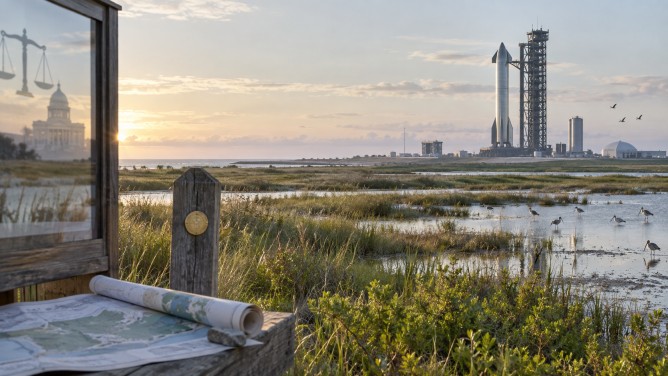
The expansion of SpaceX’s operations near the U.S.-Mexico border has sparked a legal battle over environmental concerns in Texas. A federal judge recently ruled against a preliminary injunction that sought to prevent the transfer of over 700 acres of land from the Lower Rio Grande Valley National Wildlife Refuge to SpaceX. This decision allows the land exchange to proceed, although the legal dispute continues.
Environmental and tribal groups had filed the request for an injunction, arguing that the land transfer could pose significant risks to the local environment. They expressed concerns about the potential impact on wildlife habitats, historical sites, and public access within the wildlife refuge. Despite the court’s decision, these groups have vowed to continue their legal challenge against the land swap.
Under the terms of the proposed exchange, SpaceX would receive federal land located closer to its rocket launch facility, in return offering the government 683 acres of its own land. The U.S. Fish and Wildlife Service, which previously assessed the exchange, concluded that it would not result in significant environmental harm. The agency emphasized that the deal could yield long-term conservation benefits and enhance habitat connectivity in the region.
U.S. District Judge Fernando Rodriguez Jr., in his ruling, noted that the plaintiffs failed to present adequate evidence that the land would suffer environmental, cultural, or historical damage during the ongoing lawsuit. He also highlighted the potential impact of halting the exchange on SpaceX’s development plans and existing contractual obligations.
As the case proceeds through the courts, the tension between technological advancement and environmental preservation remains a focal point. The outcome of this legal dispute will likely have implications for how similar land exchanges are handled in the future, particularly when they intersect with private sector interests and public land conservation.